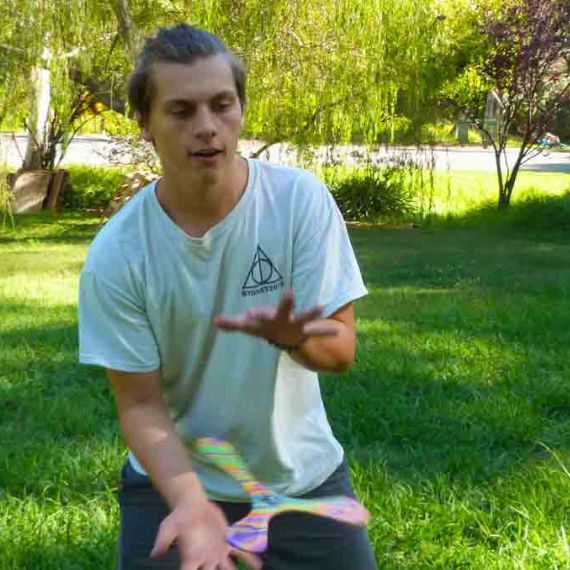
Beginners Guide to Throwing Foam Boomerangs
by
Candace Robertson
18 Mar 2026
What You Need Before You Start
Getting started with foam boomerang throwing is straightforward. Here is what you need:
Your Foam Boomerang
A quality foam boomerang is the most important piece of equipment. OZzie Emu is an excellent introductory boomerang with a range of 4–8 metres, making it manageable for beginners. The OZzie Icerunner offers a slightly longer range of; 5–14 metres for those ready to step it up.
FlyingToyz Aussie Outdoor Superang is slightly heavier with the plastic insert and designed to cut through a slight breeze. The perfect fast catch foam boomerang, with a longer range of 5-18 metres
FlyingToyz Indoor Superang is great for indoors and practicing how to throw a boomerang with a range of 2-5 metres.
An Open Space
You will need a clear, open area of at least 30 yards (approximately 27 metres) in every direction. A park, oval, or open beach is ideal. Avoid areas with trees, buildings, power lines, or other people nearby.
Light Wind Conditions
A gentle breeze is your best friend when learning to throw a boomerang. Strong winds make it significantly harder to control the flight path. If the wind is too strong, save your session for a calmer day.
Adult Supervision for Children
If children are throwing, adult supervision is essential to ensure safety at all times.
Step-by-Step Guide: How to Throw a Foam Boomerang
Step 1 — Determine Wind Direction
Wind direction is the single most important environmental factor in boomerang throwing. Before every throw, you must know exactly where the wind is coming from. The simplest method is to toss a small handful of grass or light leaves into the air and observe which direction they travel.
Once you know the wind direction, position yourself accordingly:
•Right-handed throwers: Throw approximately 45 degrees to the right of the wind direction.
•Left-handed throwers: Throw approximately 45 degrees to the left of the wind direction.
This angle allows the boomerang to ride the wind in a circular arc and return to you. If you throw directly into the wind or directly away from it, the boomerang will not return properly.
Step 2 — Hold the Boomerang Correctly
Grip is fundamental to a successful throw. The goal is to hold the boomerang in a way that allows it to spin freely as it leaves your hand — because spin, not speed, is what makes a boomerang return.
Hold the boomerang vertically, with the curved (decorated) side facing you and the flat side facing away. There are two popular grip styles for beginners:
Pinch Grip: Place your thumb on one flat face of the boomerang and your index finger on the other flat face, pinching the boomerang firmly near one of its tips. This is the most common grip for beginners.
Cradle Grip: Rest the boomerang in the cradle of your palm, with your thumb on top and your index finger wrapped around the edge. This grip can offer more control for some throwers.
Experiment with both grips during your first few sessions to discover which one gives you the most natural spin on release.
Step 3 — Set Your Stance
Stand with your feet shoulder-width apart, facing the direction you intend to throw. Your body should be relaxed and balanced. Avoid leaning too far forward or backward, as this can affect the release angle of the boomerang.
Step 4 — Tilt the Boomerang (Layover Angle)
This is one of the most misunderstood aspects of boomerang throwing. The boomerang should not be thrown flat like a frisbee. Instead, it should be held nearly vertical — tilted only slightly away from you (toward the horizon).
•In calm conditions, tilt the boomerang about 10–20 degrees away from vertical.
•In stronger wind, bring the boomerang closer to fully vertical.
•Never tilt more than 45 degrees from vertical, as this will cause the boomerang to climb steeply and then dive dangerously.
Step 5 — Aim and Prepare to Throw
Aim the boomerang at a point slightly above the horizon — imagine aiming at the tops of distant trees. This upward release angle ensures the boomerang maintains altitude throughout its circular flight path and descends gently as it returns to you.
Aiming too low will cause the boomerang to climb sharply at the end of its flight. Aiming too high will send it into the clouds. Finding the sweet spot takes a few throws, but you will feel it when you get it right.
Step 6 — Execute the Throw
This is where it all comes together. The throwing motion is similar to throwing a football or cricket ball — a smooth, overarm motion with a decisive wrist snap at the point of release.
1.Wind-Up: Bring your throwing arm back behind your head, keeping the boomerang vertical and your elbow slightly bent.
2.Forward Motion: Swing your arm forward in a smooth, controlled arc, keeping your eye on your target point above the horizon.
3.Wrist Snap: As your arm reaches the forward position, snap your wrist sharply. This snap is the key to generating the spin that makes the boomerang return. Think of it like snapping a towel.
4.Release: Let the boomerang fly naturally out of your hand at approximately eye level. Do not force it — let the spin do the work.
Key Reminder: More spin and less muscle is the mantra of experienced boomerang throwers. A gentle throw with excellent wrist snap will outperform a powerful throw with no spin every time.
Step 7 — Watch the Flight Path
After releasing the boomerang, watch its flight carefully. A well-thrown foam boomerang will travel outward in a wide arc, gradually turning, and then curve back toward you. It should hover briefly at the end of its flight before descending gently.
Observing where the boomerang lands — in front of you, behind you, to the left, or to the right — gives you valuable feedback for adjusting your next throw.
Step 8 — Catch the Boomerang Safely
As the boomerang returns and begins to hover, position yourself directly beneath it. The safest catching technique is the two-handed clap catch: hold your hands out flat, palms facing each other, and clap them together around the boomerang as it descends — like a crocodile snapping its jaws.
Avoid reaching up to grab a fast-spinning boomerang from the side, as this can cause the boomerang to strike your hand unexpectedly. Let it come to you.
Common Mistakes Beginners Make (and How to Avoid Them)
Throwing Like a Frisbee
This is the single most common mistake. A boomerang thrown sidearm (horizontally) will not return — it will simply fly away. Always throw with the boomerang held nearly vertical.
Using Too Much Force. Beginners often assume that throwing harder will make the boomerang go further and return more reliably. In reality, excessive force creates an unpredictable flight path. Smooth technique and spin are far more effective than brute strength.
Ignoring Wind Direction
Throwing without accounting for wind direction is a recipe for a lost boomerang. Always check the wind before every single throw — conditions can change quickly, especially outdoors.
Releasing Too Low
A release angle that is too flat (parallel to the ground) causes the boomerang to climb sharply at the end of its flight and land behind the thrower. Always aim slightly above the horizon.
Giving Up Too Soon
Boomerang throwing is a skill. Most beginners will not achieve a perfect return on their first throw. Stick with it, make small adjustments based on where the boomerang lands, and the returns will come.
Safety Tips for Foam Boomerang Throwing
Foam boomerangs are among the safest throwing toys available, but a few basic safety rules will ensure every session is enjoyable for everyone:
•Always check your surroundings before throwing. Ensure no people, pets, or fragile objects are in the flight path.
•Never throw at or toward people. Even soft foam boomerangs can cause discomfort at speed.
•Keep bystanders well behind the thrower, not to the sides or in front.
•Children should always be supervised by a responsible adult.
•Do not throw in strong winds. Conditions above a light breeze make the boomerang difficult to control and potentially unsafe.
•Wear sunglasses on bright days to track the boomerang against the sky without straining your eyes.
FlyingToyz Foam Boomerangs: The Best Choice for Beginners
FlyingToyz has engineered a range of foam boomerangs specifically designed to make learning fun, safe, and rewarding. Here is a quick overview of the beginner-friendly options:
|
Model
|
Range
|
Best For
|
Key Feature
|
|
|
5–18 metres
|
Kids and experienced throwers.
Ambidextrous
|
Plastic insert + foam outer skin for structure and safety. Can cut through a stronger breeze. Great for backyards, gyms, parks and ovals.
|
|
|
Short range
|
Indoor play, office, small spaces
Ambidextrous
|
Ultra-soft foam, true boomerang flight indoors.
|
|
|
5–10 metres
4-8
metres
|
Beginners ready to level up
Right handed only
|
Short range, great for backyards, gyms, open parks and ovals. No to little wind.
|
All FlyingToyz boomerangs are made with safe, durable foam and are suitable for children of all ages. They are designed to enhance agility, encourage outdoor activity, and deliver the genuine thrill of a boomerang that really comes back.